
Blog

The Science and Application of Mirror Therapy: A Complete Guide with Syrebo

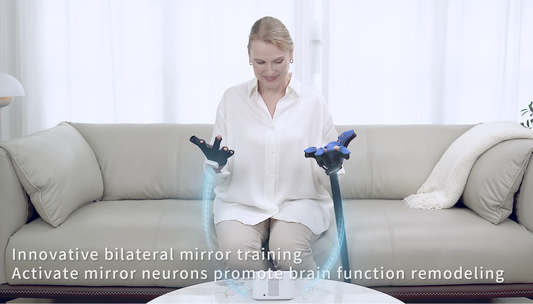
Mirror therapy — also known as Mirror Visual Feedback (MVF) — is one of the most evidence-backed rehabilitation techniques for stroke survivors. It's simple to set up, non-invasive, and can be done at home. Here's everything you need to know. What Is Mirror Therapy? Mirror therapy involves placing a mirror between your arms so that the reflection of your healthy limb creates...

On

อ่านเพิ่มเติม

How Does the Brain-Computer Interface Hand Rehabilitation Robot Work?

Imagine trying to squeeze a rubber ball — without your fingers actually moving. Despite the stillness, your brain's motor-planning regions are fully active. The Syrebo® BCI Hand Rehabilitation Robot converts this silent neural activity into real movement: a soft glove inflates, fingers extend, and a powerful feedback loop between brain and hand begins rewiring itself. The Brain's Signal: Mu Rhythms & Motor...

On

อ่านเพิ่มเติม

Neuroplasticity and Mirror Therapy: The Science Behind Stroke Recovery

Stroke interrupts neural circuits — but it doesn't erase the brain's ability to rebuild them. Understanding how neuroplasticity and mirror therapy work together gives stroke survivors and their families a scientific foundation for hope and action. How the Brain Recovers: Neuroplasticity When a stroke damages neurons, surviving brain cells quickly begin extending new connections and forming alternative pathways. These pathways mature when...

On

อ่านเพิ่มเติม

How Does Mirror Therapy Help Stroke Recovery? The Science and Practice

Every year, over 15 million strokes occur globally, with approximately half of survivors experiencing persistent upper-limb dysfunction. In the US alone, nearly 800,000 new strokes happen annually — and over 80% of those affected struggle daily with hand and arm dysfunction. The good news: these deficits aren't necessarily permanent. Mirror therapy offers evidence-based hope, and it's something you can do at home....

On

อ่านเพิ่มเติม